AI-generated illustration — not a retailer product photo.
Ceramides for Damaged Skin Barrier: A Practical Guide to a Calmer, More Tolerable Daily Routine
When skin suddenly feels tight after cleansing, stings when a familiar serum goes on, or starts shedding around the nose and mouth, the instinct is often to add more products. That is usually how a once-manageable routine becomes harder to read. A ceramide moisturiser can be a useful steady layer, but it is not a rescue button and it cannot compensate for continued over-exfoliation, harsh cleansing, or a rash that needs medical assessment.
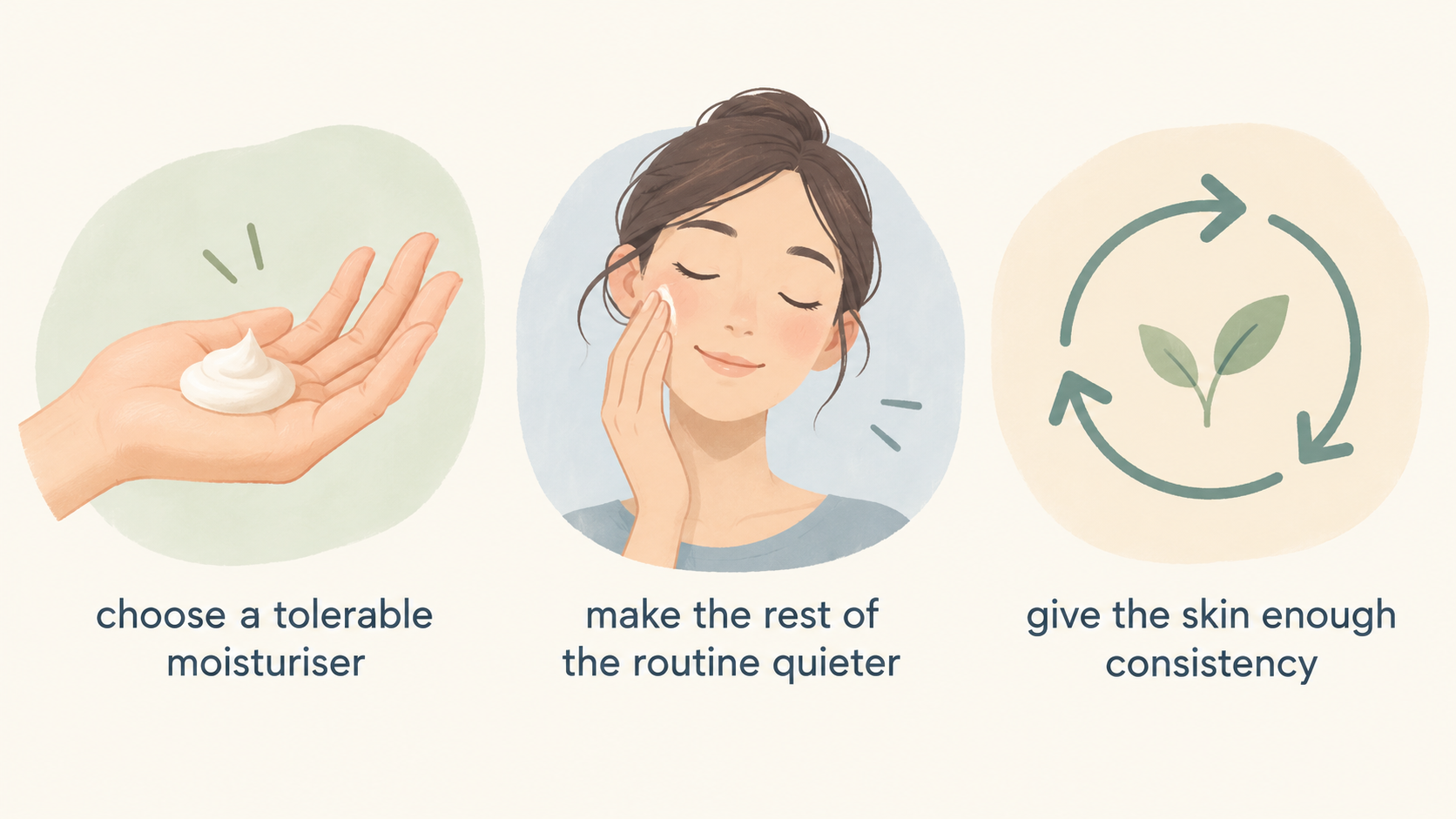
The practical case for ceramides for damaged skin barrier support is simple: choose a tolerable moisturiser, make the rest of the routine quieter, and give the skin enough consistency to show you whether it is improving. This guide is about everyday skincare decisions, not diagnosis or treatment. If skin is painful, cracking, bleeding, or persistently irritated, see a dermatologist rather than layering on more products.
Scope note: This is an ingredient-and-routine guide based on current official product information and dermatology guidance. It does not claim first-hand testing or promise a medical outcome.
What ceramides can—and cannot—do for a compromised routine
AI-generated illustration — not a retailer product photo.
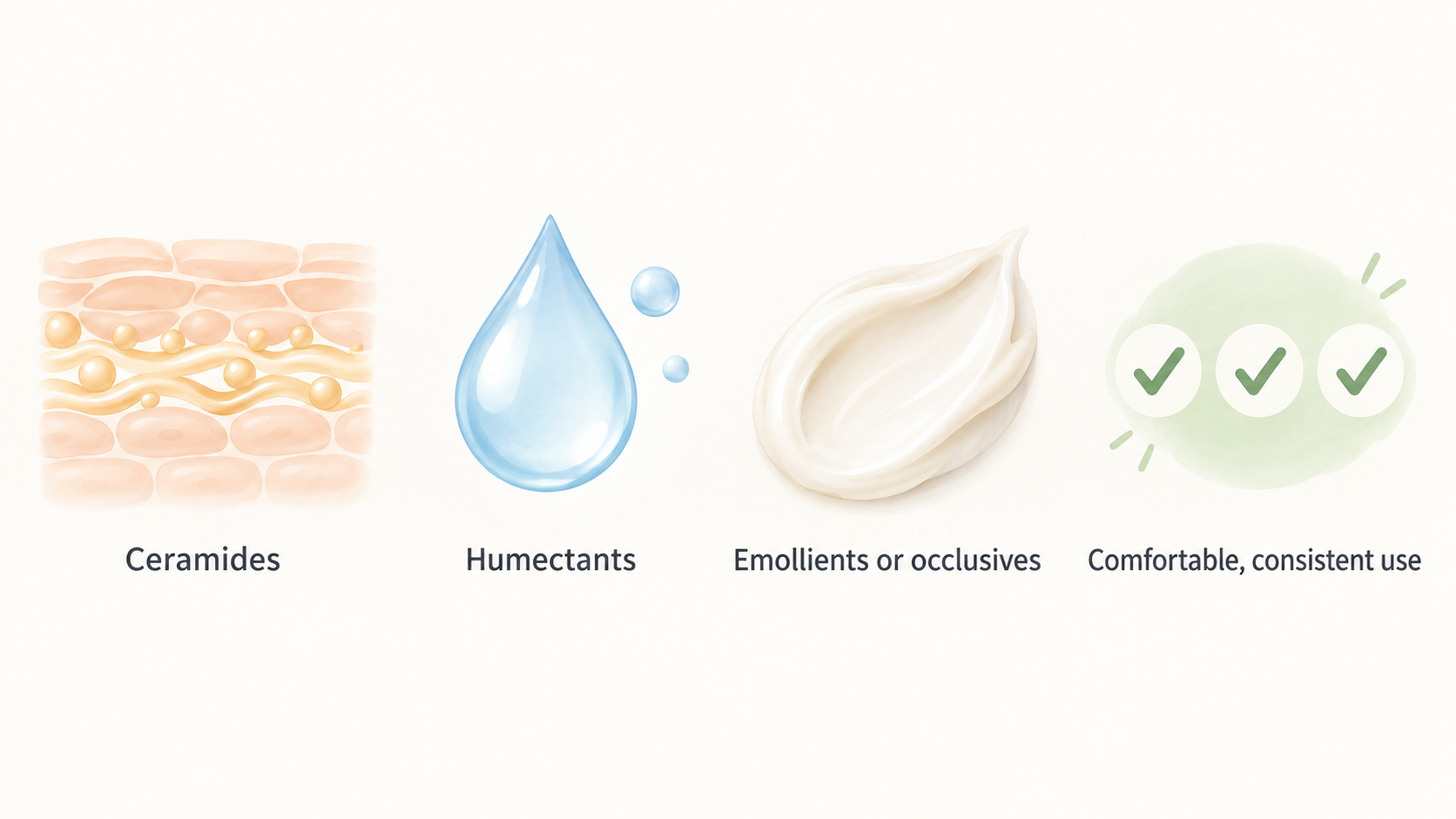
Ceramides are lipid molecules found naturally in the outer skin layer. In a moisturiser, they are commonly paired with humectants such as glycerin or hyaluronic acid and with emollient or occlusive ingredients that make a formula feel more substantial. The useful question is not whether a label has the largest ceramide count. It is whether the whole formula is comfortable enough for you to apply consistently while your routine is simplified.
The American Academy of Dermatology’s moisturiser guidance points dry, sensitive skin toward fragrance-free options and notes ceramides among ingredients that can help hydrate skin. Its advice also puts texture in context: creams and ointments tend to hold water more effectively than a light lotion for notably dry skin. That does not mean every oily or acne-prone person needs a dense cream across the whole face.
Ceramides also do not replace sunscreen, prescribed treatment, or a review of potential irritants. If a product burns every time you use it, do not persuade yourself that “repair” must feel intense. A calmer routine is usually easier to evaluate than one built from several newly introduced serums.
Start with the pattern, not a dramatic “barrier damage” label
AI-generated illustration — not a retailer product photo.
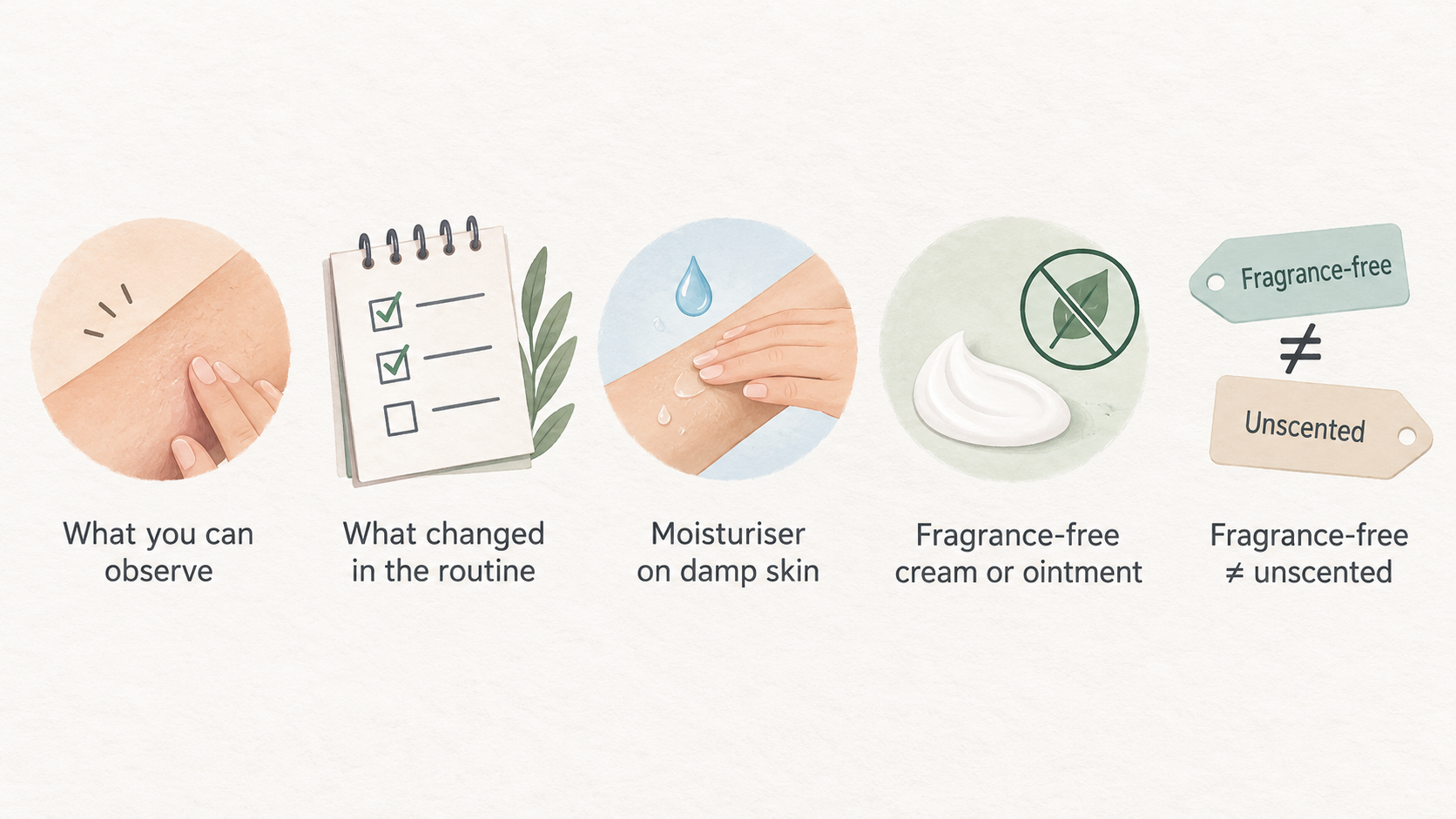
“Damaged skin barrier” is often used online to describe several different experiences: dryness, flaking, temporary sensitivity after strong actives, irritation from weather, or a flare of an underlying condition. Those experiences can overlap, but they are not interchangeable. Start with what you can observe and what changed in the routine before deciding what to buy.
| What you notice | First routine adjustment | Ceramide texture to consider | When not to self-manage |
|---|---|---|---|
| Tightness after cleansing, mild flaking | Use a gentle cleanser only where needed; pause scrubs | Cream or lotion, depending on comfort | Persistent stinging or worsening rash |
| Dry, rough cheeks with an oily T-zone | Moisturise dry zones rather than blanket-layering | Light lotion or cream on dry areas | New painful acne or swelling |
| Skin feels reactive after retinoid or acid use | Reduce frequency or pause the active temporarily | Fragrance-free cream with a simple routine | Cracks, bleeding, severe itch, or eye-area involvement |
| Winter or indoor-heating dryness | Shorter, lukewarm cleansing; apply moisturiser while skin is slightly damp | Cream; ointment for very dry body areas | Symptoms that do not improve with a simplified routine |
AAD advises applying moisturiser after bathing or washing while skin is still damp, and recommends fragrance-free cream or ointment for overly dry skin. It also distinguishes “fragrance-free” from “unscented”: the latter can still contain fragrance-related ingredients intended to mask odour. That distinction matters more when your skin is already reactive than a fashionable ingredient claim on the front label.
Choose the formula by feel, routine position, and tolerance
AI-generated illustration — not a retailer product photo.

For very dry or tight-feeling skin, a richer cream may be the sensible starting point because it helps reduce the temptation to reapply several lighter layers. CeraVe Moisturising Cream lists ceramide NP, ceramide AP, ceramide EOP, cholesterol, glycerin, petrolatum, dimethicone, and hyaluronic acid in its UK ingredient list. The brand describes it as fragrance-free and suitable for normal to dry skin.
That ingredient context makes it a reasonable example for someone who wants a substantial, uncomplicated moisturiser for dry areas. It is not automatically the right choice for every face. A pot also asks for clean, dry hands or a clean spatula; that is a small packaging habit, but one that matters when the product is being used repeatedly on irritated-feeling skin. Check the actual package before purchase because brands can update ingredient lists.
For someone who wants a more deliberately face-focused, richer formula, Dr.Jart+ Ceramidin Skin Barrier Moisturizing Cream is another example. Its official page describes a 5-ceramide complex with panthenol and glycerin, and says the formula is free from added fragrance, mineral oil, phthalates, parabens, sulfates, and alcohol. The brand also publishes its own clinical and consumer-test claims with sample sizes; treat those as manufacturer evidence, not as a guarantee of your personal result.
Neither example needs to become a routine trophy. Choose one product you can tolerate, introduce it to a small area first if you are reactive, and keep the surrounding routine stable long enough to learn from it.
A seven-day ceramide routine reset
A reset does not need a new ten-step routine. For one week, the goal is to remove noise rather than chase rapid change.
Morning: cleanse only if you need to, or rinse with lukewarm water; apply your ceramide moisturiser where skin feels dry; finish with a separate broad-spectrum sunscreen. Moisturiser and sunscreen have different jobs, so one does not replace the other.
Evening: use a gentle cleanser to remove sunscreen and makeup; apply the ceramide moisturiser to slightly damp skin; stop there unless a clinician has told you to use a treatment. Avoid adding a scrub, peel, new vitamin C product, or another “repair” serum during the same reset.
After day seven: decide from your skin’s response, not from a product’s popularity. If tightness and flaking are settling, you can keep the simplified baseline and reintroduce one active slowly. If burning, redness, or scaling is getting worse, stop experimenting and seek professional advice.
This approach is intentionally less exciting than buying several barrier products. It is more useful because it gives you a readable baseline. AAD advises gentle cleansing, short warm showers, and regular application of fragrance-free moisturiser for dry skin; those basic steps often matter as much as the hero ingredient.
Where ceramides fit around retinol and exfoliating acids
Ceramides work well as the routine’s plain layer, especially when the rest of the routine includes an active that can be irritating when overused. They do not make it sensible to push through persistent burning or to increase retinoid or acid frequency because the moisturiser feels rich.
If you are restarting retinol, use this guide alongside our beginner retinol routine. Start with the schedule your skin can tolerate, then use a moisturiser before or after the active according to the product directions and your comfort. Keep the number of variables low. The point is not to force a specific “sandwich” technique; it is to avoid treating discomfort as proof that a treatment is working.
The same restraint applies to exfoliants. If you are unsure whether an AHA, BHA, or PHA belongs in your routine, read our AHA vs BHA vs PHA guide before adding one. Dry, peeling skin is not an automatic signal to exfoliate more. When the surface is already reactive, a pause can provide clearer information than another acid layer.
Product fit: cream, lotion, or a lighter targeted layer?
Texture is a routine decision, not a moral category. A thick cream can be excellent on dry cheeks but feel uncomfortable through an oily centre face. A lighter lotion may be easier under sunscreen but insufficient for body areas that crack in cold weather. Apply where the skin needs it; you do not have to use one texture everywhere.
If your face is combination, consider using a richer ceramide cream on the dry perimeter and a lighter layer—or no extra layer—on areas that become congested easily. If your skin is acne-prone, introduce a new moisturiser gradually and observe whether it causes a pattern of congestion rather than assuming every spot is “purging.” For a broader product-led overview, see our barrier repair moisturiser shortlist.
Be particularly cautious with fragrance when skin is reactive. “Natural,” botanical, or strongly scented does not automatically mean gentle. The AAD notes that fragrance can irritate dry or sensitive skin, and that a label saying “unscented” is not the same as “fragrance-free.” Keep that in mind when comparing a sleekly marketed balm with a plain-looking pharmacy cream.
Common mistakes that keep the routine hard to read
The first mistake is introducing three new “barrier” products at once. If the routine then stings or breaks out, you cannot tell which product caused it. Add one formula, keep it consistent, and avoid changing cleanser, exfoliant, and moisturiser in the same week.
The second mistake is confusing surface dryness with a need for more exfoliation. A visible flaky patch can be tempting to polish away, but repeated friction and acid use may make tolerance worse. Put the exfoliant aside temporarily and focus on gentle cleansing, moisturising, and sunscreen. If you are also deciding whether to use niacinamide or vitamin C, our niacinamide vs vitamin C comparison can help you avoid stacking several changes at once.
The third mistake is treating skincare as a substitute for care when symptoms are severe. Pain, bleeding, marked swelling, a spreading rash, or persistent irritation deserve assessment. A ceramide moisturiser can be a supportive cosmetic step, but it does not diagnose eczema, allergy, infection, or another skin condition.
FAQ
Can I use ceramides every day?
Usually, a straightforward ceramide moisturiser is designed for regular use, but the product instructions and your own tolerance still matter. Start once daily if you are cautious, then move to morning and evening if it remains comfortable. If it stings repeatedly, stop and reassess the formula rather than increasing frequency.
Should I use ceramides before or after retinol?
Use them as the moisturising layer around your retinol routine, but do not assume there is one mandatory order for everyone. A moisturiser before retinol may feel more tolerable for some people; applying it afterwards may suit others. The more important rule is to introduce retinol slowly and not add acids on the same night if your skin is already reactive.
Are ceramides enough for very dry skin?
Ceramides can be useful, but very dry skin may also need a cream or ointment texture, gentler cleansing, and more frequent application. AAD recommends fragrance-free creams or ointments for overly dry skin. If the skin is cracking, painful, bleeding, or not improving, seek dermatology advice instead of escalating cosmetic products alone.
Do I still need sunscreen if my moisturiser supports my barrier?
Yes. A moisturiser supports comfort and hydration; sunscreen addresses UV exposure. Use a separate broad-spectrum sunscreen in the morning and choose a finish you will apply consistently. Keeping sunscreen in the routine is especially useful when you later reintroduce retinoids or exfoliating acids.
Related reading
Build the routine outward from a simple baseline:
- How to start a beginner retinol routine
- AHA vs BHA vs PHA: choosing an exfoliating acid
- Barrier repair moisturisers by ingredient context
- Niacinamide vs vitamin C by skin goal
Sources and affiliate disclosure
Product information was checked against the official CeraVe Moisturising Cream page and Dr.Jart+ Ceramidin page on 13 July 2026. Routine and dry-skin guidance is informed by the American Academy of Dermatology’s advice on relieving dry skin.
Dave Roberts may earn a commission from qualifying links, at no extra cost to you. That does not change the editorial approach: product formulas can change, suitability is individual, and skincare is not medical care. Read our About page and editorial policy for how we assess products and disclose commercial relationships.
Editorial information: Read our affiliate disclosure.