Disclosure: This is an editorial comparison, not medical advice. Product pages are linked to verify current formula and price; we do not claim hands-on testing. Read our editorial policy and affiliate disclosure before using commercial links.
Niacinamide vs Vitamin C: Which Active Fits Your Skin Goal?
The harder skincare decision is rarely “Which serum is more popular?” It is deciding what you need the serum to do before you add another bottle to an already busy shelf. If your face is shiny by lunchtime, congestion is a pattern, or your routine becomes uncomfortable whenever you add an active, niacinamide may be the more sensible first question. If dullness, uneven-looking tone, or visible sun-related change is what you notice most, vitamin C may be the more relevant one.
The practical answer is not that one ingredient wins. Niacinamide and vitamin C solve different parts of the routine decision. Niacinamide has a stronger case when you want a simple, water-based product aimed at oiliness and texture. Vitamin C has a clearer role when your priority is antioxidant support and the look of uneven tone, but its formula, packaging and tolerance deserve more scrutiny.
Our comparison is source-led: we checked current brand pages, ingredient lists, published dermatology guidance and research rather than presenting first-hand testing as fact. About our editorial team explains how this desk evaluates products.
Niacinamide vs vitamin C at a glance
AI-generated illustration — not a retailer product photo.
| Question | Niacinamide | Vitamin C |
|---|---|---|
| Main reason to consider it | Oiliness, visible shine, congestion-prone routines, texture and barrier-oriented support | Dullness, uneven-looking tone and a morning antioxidant-focused routine |
| Typical routine position | Often a water-based serum after cleansing and before heavier products | Usually a morning serum after cleansing and before moisturiser and sunscreen |
| Formula issue to check | Concentration and whether a simple formula feels comfortable over time | Vitamin C form, packaging, oxidation risk and any supporting acids or fragrance |
| Tolerance question | A high-strength formula can still be too much for some people | Pure ascorbic acid formulas can sting or feel drying, especially with other actives |
| Best first step | Start with one product and observe skin for several weeks | Start with one product, use sunscreen daily and avoid adding several new actives at once |
| Value lens | Compare bottle size, concentration and whether it replaces a more complicated routine step | Compare formula and packaging before price alone; a low price is not useful if the serum destabilises or irritates |
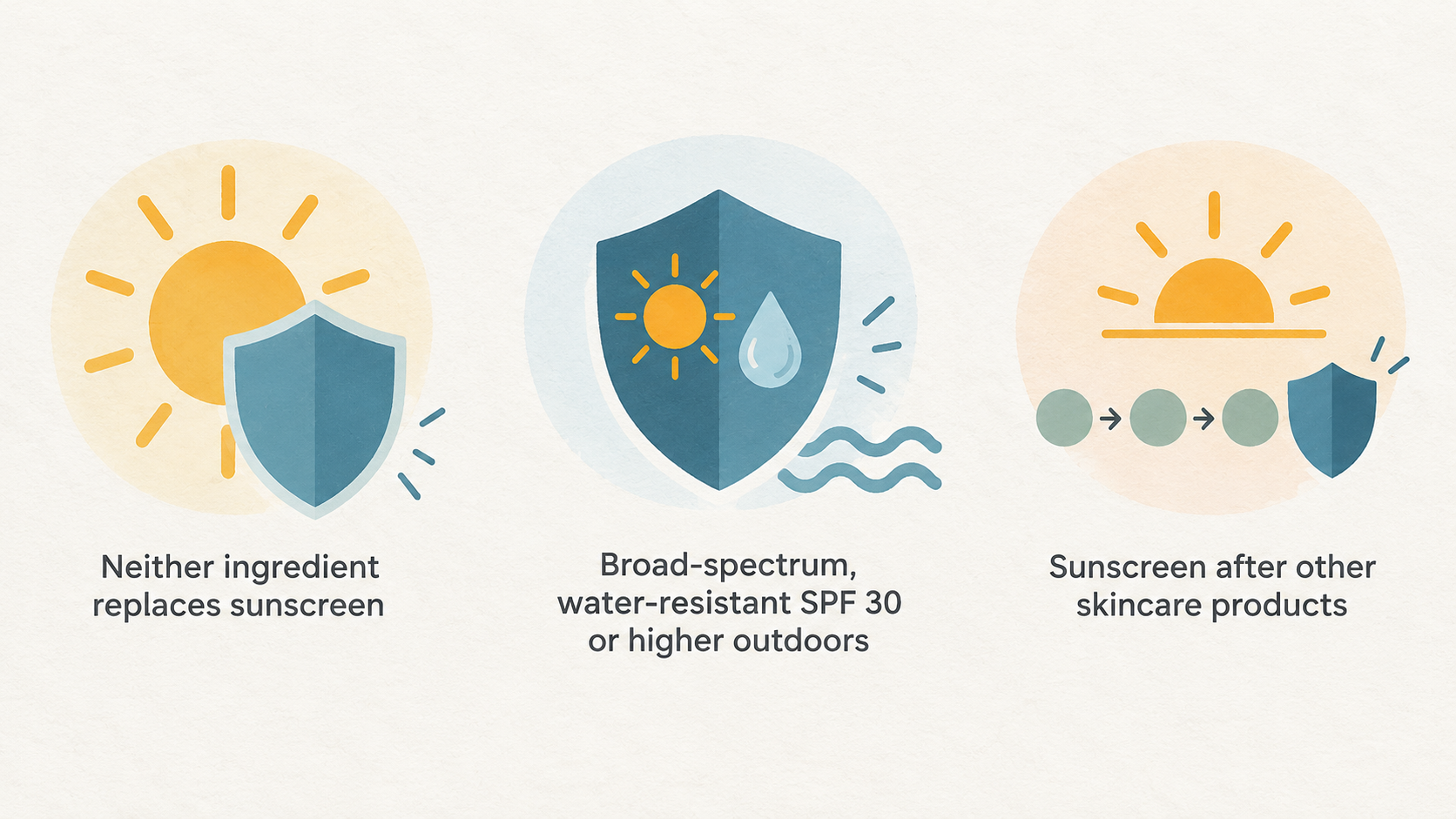
Neither ingredient replaces sunscreen. The American Academy of Dermatology recommends broad-spectrum, water-resistant SPF 30 or higher when you are outdoors, and places sunscreen after other skincare products in a morning routine. That is especially relevant if uneven tone or photoageing is part of the reason you are shopping for vitamin C in the first place. Our daily facial sunscreen comparison is a useful next read.
What the evidence supports — and what it does not
AI-generated illustration — not a retailer product photo.
There is evidence behind both ingredients, but it is more useful to read it narrowly than to turn it into a miracle claim.
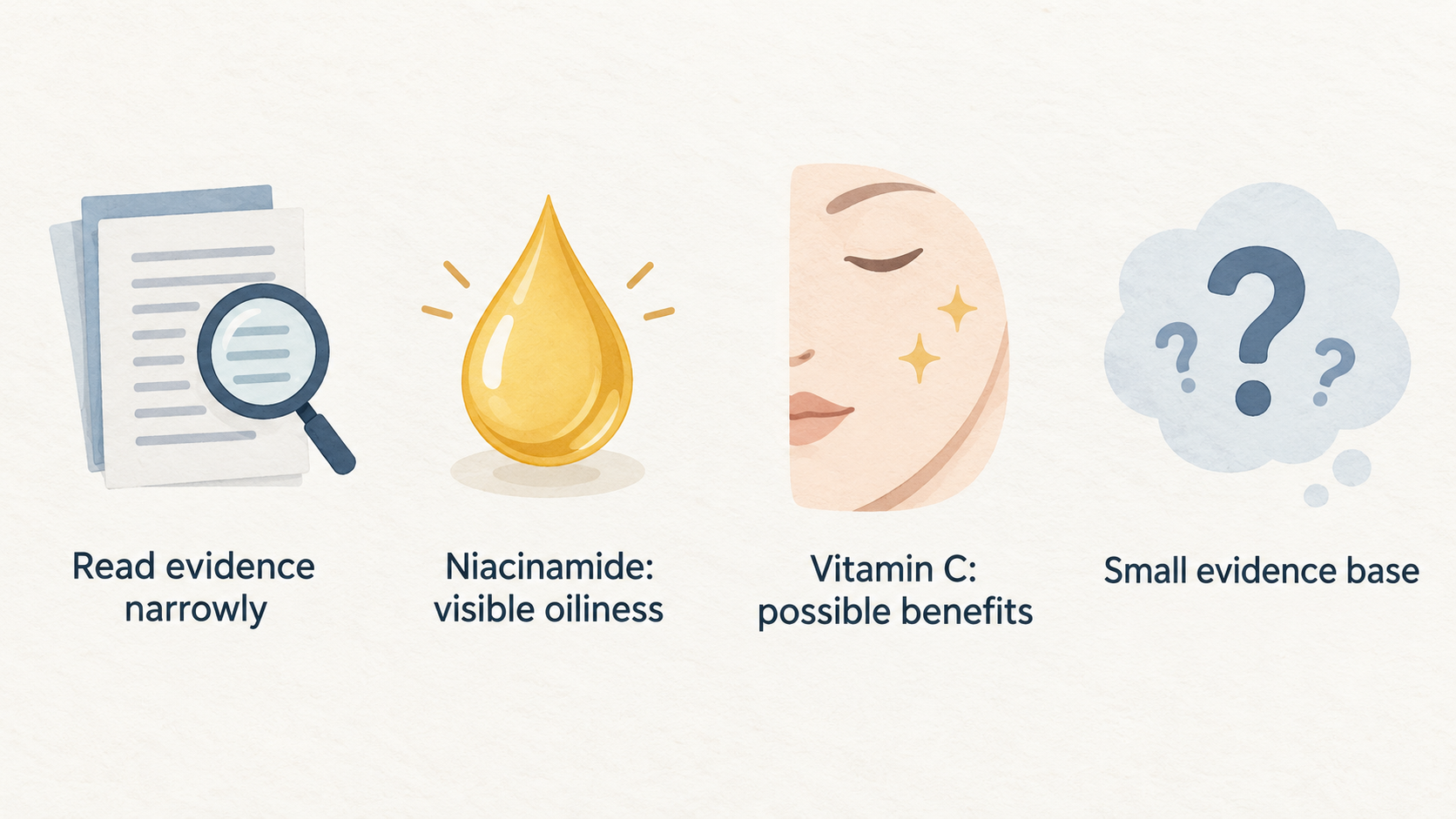
A 2006 study of topical 2% niacinamide found reduced measures of facial sebum in two populations after several weeks of use. That supports niacinamide as a reasonable ingredient to investigate for visible oiliness; it does not prove that every product using 10% niacinamide will produce the same outcome for every person. Read the study details on PubMed.
For vitamin C, a systematic review of topical studies found possible benefits for uneven, photoaged-looking skin, while also noting the small evidence base and uncertainty around the ideal concentration. The relevant question is therefore not simply “Does it contain vitamin C?” but “Which form, in what packaging, and can I use it consistently without irritation?” The review is available on PubMed.
Dermatology guidance is also practical rather than absolute. The AAD notes that vitamin C serum or cream can be used in the morning before sunscreen for people targeting signs of skin ageing or dark spots. It also advises introducing products carefully and stopping a product that irritates your skin. See its guidance on morning skincare routines and testing new products.
Choose niacinamide when oiliness and routine comfort lead the decision
Niacinamide is vitamin B3, but topical skincare decisions are about the whole formula rather than the name alone. For a shopper with visible shine, congestion or a tendency to over-correct with drying acids, a simple niacinamide serum may be easier to place in a routine than a more acidic treatment.
A current example is The Ordinary Niacinamide 10% + Zinc 1%. At the time of checking on 12 July 2026, the brand listed its 30ml size at £5. Its ingredient list starts with water and niacinamide and also includes Zinc PCA; the page describes it as a water-based serum and lists a pH range of 5.00–6.50. Those details make it a clear example of a focused, low-cost oil-control route, not proof that it is automatically gentle for everyone.
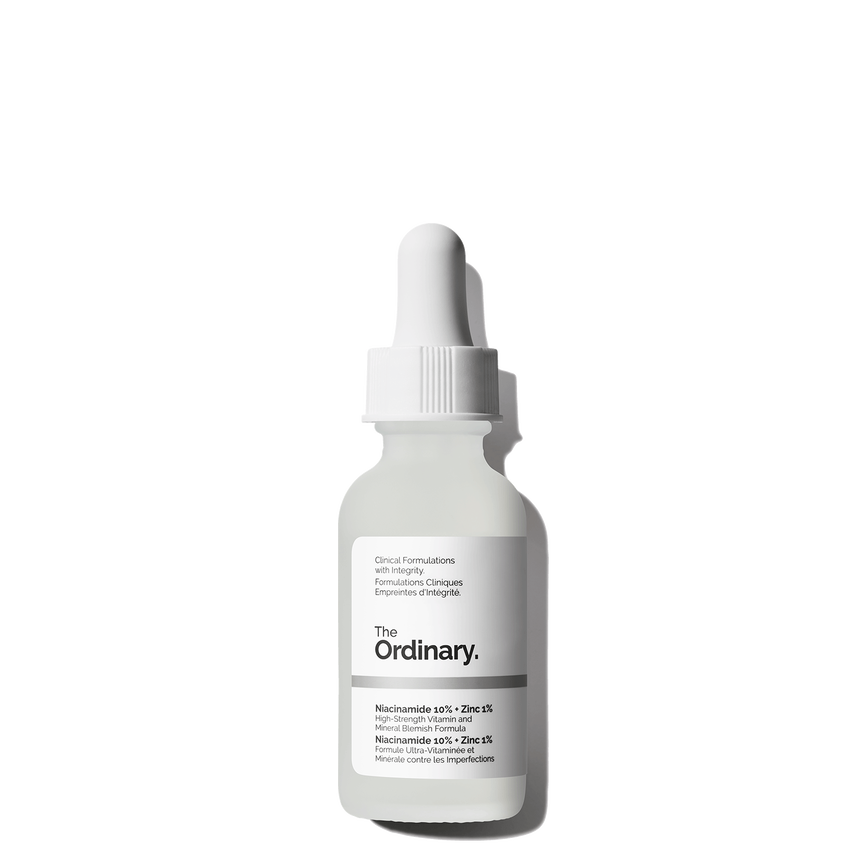
The value argument is straightforward: £5 for 30ml gives a low-cost entry point if you are testing whether this category fits your routine. The limitation is equally straightforward: a 10% concentration is not a universal starting point, and product tolerance cannot be inferred from price or popularity. The brand advises patch testing and says to stop use if irritation occurs. The AAD similarly recommends testing a new product on a small area before regular use.
Choose a niacinamide route first if:
- oiliness, visible shine or congestion is more pressing than dullness;
- you want a serum that can sit in a simple routine without adding another exfoliating step;
- you are rebuilding a routine after irritation and want to avoid introducing several actives at once;
- you are comparing face serums primarily by routine fit and value.
For a broader product shortlist by concern, see our face serum guide. If your skin is dry, reactive or over-exfoliated, also compare the barrier-support context in our moisturiser shortlist.
Choose vitamin C when dullness or uneven tone is the clearer priority
Vitamin C is an antioxidant category, not one identical ingredient experience. L-ascorbic acid is the form many people mean when they talk about “pure vitamin C,” but stability, packaging and companion ingredients make a practical difference. DermNet notes that topical vitamin C can be useful when formulated stably, while also warning that many available formulas may not be sufficiently stable or well absorbed. Read its dermatologist-reviewed overview of topical vitamin C.
La Roche-Posay Pure Vitamin C10 Serum is a current UK example of a more complex pure-ascorbic-acid serum. At the time of checking on 12 July 2026, its 30ml page showed £36, reduced from £45. The published ingredient list includes ascorbic acid, salicylic acid, alcohol denat. and fragrance; the brand also says its packaging uses a UV filter intended to protect the active molecule from UV-related degradation.
That formula can appeal if your main objective is radiance and uneven-looking texture, but it carries a different tolerance conversation from a minimalist niacinamide serum. Salicylic acid adds another active dimension, while alcohol and fragrance are relevant if your skin is already reactive. “Suitable for sensitive skin” on a product page is useful context, not a guarantee that every sensitive skin type will be comfortable with it.
Choose a vitamin C route first if:
- dullness, uneven-looking tone or early photoageing is your clearer priority;
- you will use a daily broad-spectrum sunscreen consistently;
- you are willing to judge the formula and packaging, not just the vitamin C percentage;
- your routine does not already include multiple potentially irritating actives.
Can you use niacinamide and vitamin C together?
Sometimes, but “can” is not the same as “should start with both.” The more useful first decision is whether you can identify what is helping or irritating your skin. Adding two new active serums at once makes that harder.
Brand instructions can differ. The Ordinary’s current page recommends using its niacinamide and vitamin C products in separate routines. Treat that as product-specific guidance for that formulation rather than a universal rule for every niacinamide and vitamin C product. A careful route is to begin with one active for several weeks, then consider the second only if the first is comfortable and your skin goal still calls for it.
A simple example is:
- Cleanse gently.
- Use one active serum, not a stack of new actives.
- Add moisturiser if your skin needs it.
- In the morning, finish with broad-spectrum sunscreen.
If you feel burning, persistent redness, itching or swelling, wash the product off and stop using it. The AAD recommends seeking professional advice when a reaction is severe, persistent or difficult to identify.
The decision tree: which one should you buy first?
Choose niacinamide first when your question is “How do I make my routine less oily, congested or overcomplicated?” A low-cost, simple water-based formula can be a useful test, provided you introduce it carefully.
Choose vitamin C first when your question is “How do I build a morning routine around dullness or uneven-looking tone?” The answer includes sunscreen, formula stability and tolerance; vitamin C should not be treated as a replacement for sun protection.
Choose neither first if your skin is currently stinging, peeling, flaring or reacting to several products. In that situation, reducing the number of active steps and returning to gentle cleansing, moisturiser and appropriate sunscreen is often a more rational purchase decision than adding another serum. This is not a diagnosis; persistent acne, eczema, rosacea or pigment changes warrant individual advice from a clinician or dermatologist.
Price, packaging and retailer value
The Ordinary’s £5 30ml niacinamide serum and La Roche-Posay’s £36 30ml vitamin C serum demonstrate why price per bottle alone is a weak comparison. They are not trying to do the same job, and the vitamin C formula’s packaging stability is part of what you are paying to assess.
Do not invent a “price per month” figure unless you know how much product you use and whether you use it once or twice daily. Instead, check:
- bottle size and the brand’s stated routine frequency;
- whether the product includes other actives you already use;
- packaging that protects vitamin C from light and air where relevant;
- retailer returns, delivery and current price on the day you buy;
- whether a lower-cost product lets you test a category without creating a complicated routine.
For more existing editorial reading, browse our serum-by-skin-goal picks, barrier-repair moisturiser picks, daily SPF50 comparison and the top-picks library.
Frequently asked questions
Is niacinamide or vitamin C better for dark spots?
Vitamin C has a clearer direct role in many routines aimed at uneven-looking tone, and AAD guidance includes it among ingredients people may consider for dark spots. But sunscreen use, the cause of pigmentation, formula tolerance and consistent use all matter. Neither ingredient should be presented as a guaranteed treatment for every type of hyperpigmentation.
Is niacinamide better for oily skin?
Niacinamide is a reasonable ingredient to investigate when visible oiliness is the leading concern. Research on topical 2% niacinamide found changes in measures of sebum, but that does not guarantee a result from a different concentration or formula. Choose a product with a clear ingredient list and introduce it without adding several other actives.
Should I use vitamin C in the morning?
AAD guidance places vitamin C after cleansing in the morning and before sunscreen. That sequence makes practical sense for a routine focused on antioxidant support, but follow the specific product instructions and stop if it causes persistent irritation. Sunscreen remains the essential final daytime step.
Can sensitive skin use either ingredient?
Possibly, but sensitivity is not one uniform condition. A simple niacinamide formula may suit some people, while a pure vitamin C formula containing acids, alcohol or fragrance may be less comfortable for others. Patch test first, introduce one product at a time, and seek professional advice for ongoing reactions or a diagnosed skin condition.
Final verdict
Choose niacinamide when you need a calmer, more oil-aware starting point. Choose vitamin C when dullness and uneven-looking tone are your actual priorities and you are ready to make sunscreen non-negotiable. The better serum is the one that matches a specific skin goal, has a transparent formula, and is comfortable enough to use consistently — not the one with the loudest claim.
Sources
- The Ordinary: Niacinamide 10% + Zinc 1%
- La Roche-Posay UK: Pure Vitamin C10 Serum
- American Academy of Dermatology: skincare routine guidance
- American Academy of Dermatology: testing skincare products
- PubMed: topical niacinamide and facial sebum
- PubMed: systematic review of topical vitamin C
- DermNet: topical vitamin C
Title Candidates
- Niacinamide vs Vitamin C: Choose by Skin Goal, Not Hype
- Oily Skin or Dullness? The Niacinamide vs Vitamin C Decision
- Niacinamide vs Vitamin C: A Routine-First Serum Comparison
- Before You Buy a Serum: Niacinamide vs Vitamin C Explained
- Vitamin C or Niacinamide? Start With the Skin Goal You Can Name